“Proper light at the proper time” is more precise than “healthy light.”
Editorial illustration. Product behavior and final measurements remain subject to engineering validation.
The short answer
The useful question is not whether a lamp is healthy. It is what light reaches the eyes, when, for how long, and in what context.
Daytime, the hours before bed and sleep call for meaningfully different light exposure. Timing belongs in the design brief.
The pattern matters
The 2024 CIE position statement supports a strong daily contrast: higher light exposure during the day, much lower exposure during the three hours before bed, and near-darkness during sleep. It also warns that integrative lighting must still manage glare, visual quality, architecture and energy.
That is why Harlowelife does not reduce a day to four color-temperature presets. Time establishes a trajectory; the task and the actual room still shape the useful setting.
Why color temperature is not enough
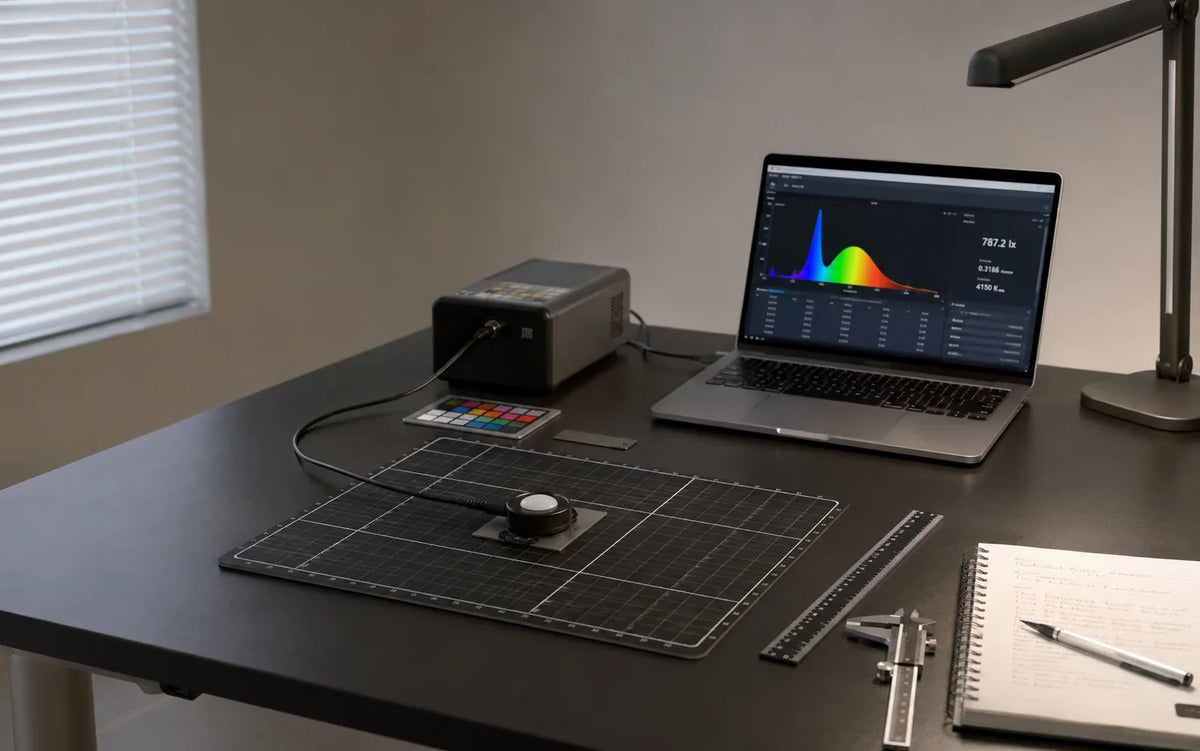
Two white lights with the same correlated color temperature can differ in spectral power distribution. CIE S 026 provides a standardized way to characterize stimulation of the five α-opic photoreceptor classes, including melanopic equivalent daylight illuminance.
A metric describes the delivered stimulus. It is not a health score, and it does not remove the need to evaluate illuminance, uniformity, glare, flicker and color quality.
What this does not prove
The evidence boundary
General recommendations for healthy adults do not prove that Anchor, Axis, Aura or Ritual One improves sleep, alertness or health. Those outcomes require product-specific human data.