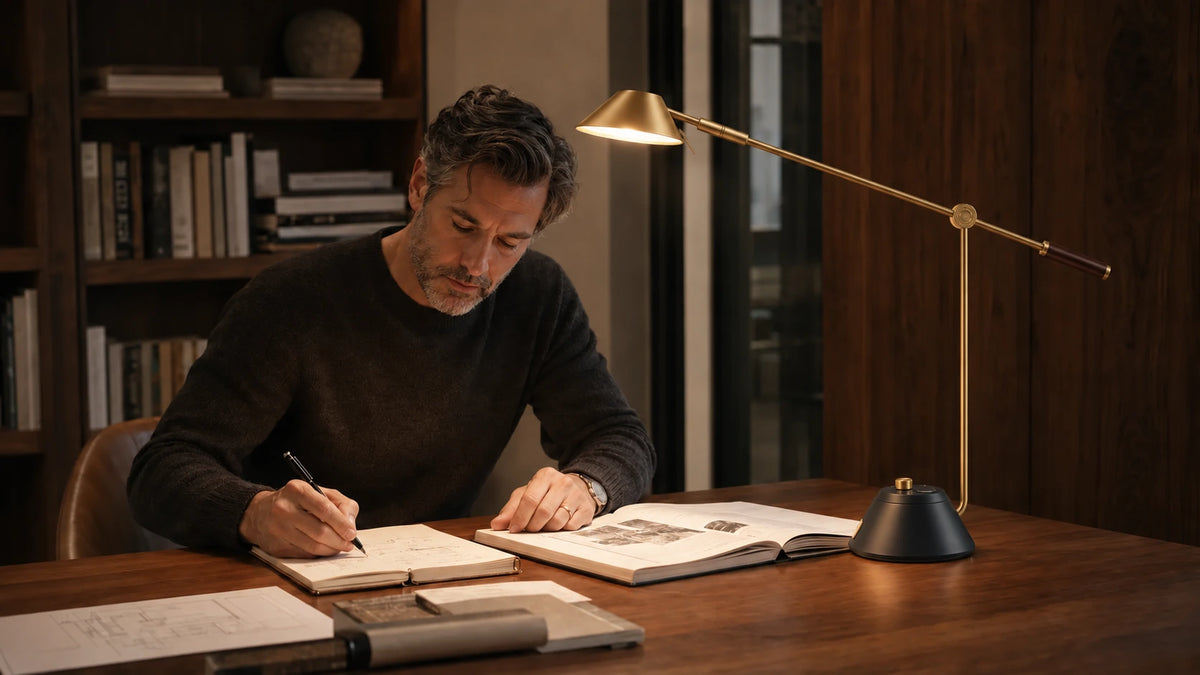
02 / WHEN READING CONTINUES INTO THE EVENING1800K.
1800K.
Still light for the page.
Choose deep-warm task light when work runs late. We measured the work surface and eye position using the same SOLA Desk sample.
Daytime task setting
6500K
658.2Average task-plane illuminance / lx
211.9Central eye-level mEDI / lx
Task-plane illuminance and melanopic light at the eye, measured in the same fixed setup.
305 lx
Average task-plane lux at 1800K
Nine-point average on a 60 × 40cm plane.
85%
About 85% lower eye-level mEDI
This sample’s 6500K → 1800K setting.
Both settings at their respective full outputs. Task-plane illuminance also decreased. The 85% figure compares this sample’s settings.
Read the paired measurements and test conditions
Both settings were measured at their respective full outputs in a fixed setup. At 6500K: average task-plane illuminance 658.21lx, central eye-level photopic illuminance 202.1lx and mEDI 211.9lx. At 1800K: 305.08lx, 89.9lx and 31.5lx respectively. The 85.13% reduction in eye-level mEDI accompanied a 53.65% reduction in task-plane illuminance.
| SOLA Desk setting | Task-plane average / lx | Central eye-level mEDI / lx |
|---|---|---|
| 6500K | 658.21 | 211.9 |
| 1800K | 305.08 | 31.5 |
Source: Solar desk&Solar floor eye-level and task-plane test workbook, solar desk sheet. mEDI means melanopic equivalent daylight illuminance. Position and other light sources affect exposure. This is a comparison of settings on one Desk sample, not an equal-illuminance spectral A/B, a competitor advantage or a sleep outcome. It does not describe Floor or Halo performance.
A separate uniformity test covered 70 × 50cm with 45 points, recording 523–670lx with the emitter 1m above the plane. Its conditions differ from the nine-point and eye-level test above.
Why your desk needs its own light
A bright room does not always mean
the right light at your hands.
Good light, across your desk.
From the page to the notes beside it.
Even light across a 70 × 50 cm work area.1
Even light. Look closer.
Test plane illustration70 × 50 cm 45 measured points

Edge point · Point 22x 70 cm · y 20 cm
523 lx
Work mode · Light-emitting surface 1 m above test plane · One ESL sample · Internal test
Test conditions and calculations
Report LAB2026082102, completed August 26, 2026. One sample in work mode, with the light-emitting surface 1 m above the test plane. The report specifies a 700 × 500 mm outer area and a 500 × 300 mm central area. This display shows the 45 points in the outer area; it does not extend the measured coverage to a larger desk.
The edge point at x 70 cm, y 20 cm reads 523 lx, the lowest value in this test. The center at x 35 cm, y 25 cm reads 670 lx, the highest. The report defines uniformity as maximum ÷ minimum: 670 ÷ 523 ≈ 1.28; values closer to 1 indicate more similar readings. Conversely, 523 ÷ 670 ≈ 78% means this edge point receives approximately 78% of the center illuminance. This is not a performance score, perceived brightness percentage or improvement over another lamp. It is also different from minimum ÷ average uniformity (U₀).
The desk image is a generated scene illustration. The 45 selectable points follow the relative positions in the original report; the dotted lines are coordinate guides. The nominal 70 × 50 cm area does not mean the book, hands or every surface in the photograph was measured. The report contains no continuous surface data. No illuminance is interpolated between points.
The original report is filed under an ESL sample, with the project name “Human-centric desk lamp” and a blank model field. It is presented here in association with the supplied SOLA Desk product materials. Desk size, lamp position, mode and ambient light affect the distribution. These readings are separate from the 40 cm test on the product page.
Download all 45 measurements ↗One desk, different tasks
One lamp. Four ways to light the same desk.
For screens, reading, detailed work and video calls, choose your task, then position the arm and lamp head to direct light where you need it.

REAL TASK
See the keyboard. Consider the screen.
The long arm positions the lamp head beyond the screen, keeping the keyboard and desktop visible while reducing direct conflict between the light source and the display.

REAL TASK
Keep the light between the page and your hands.
Move the lamp head above the page for clear, continuous reading light, without moving the base or changing your seating position.

REAL TASK
Bring clearer light to the detail in front of you.
Drawing, models, craft and close inspection call for deliberate light placement. The arm reaches across the desk so the head can stay close to the task.

REAL TASK
When you need to be seen, turn the light toward you.
Before a meeting, manually turn the lamp head toward your face to establish a clearer main light direction. Afterwards, turn it back toward the desk.
SOLA Desk
US reference price
US reference price: $599.00 USD
Final specifications, availability and delivery details will be confirmed before purchase.
Get product updatesDifferent inputs. Different roles.
Light sensing reads the desk.
Radar senses presence.
Detecting someone is not the same as identifying their task. You choose the activity and daily schedule.

Light sensor
Measures light at the actual task position, giving adjustments a reading from your work surface.
Learn about task-position sensing ↗24 GHz radar
Provides a presence input. Follow the product instructions for sensing range and control settings.
Your choice
Choose a task and schedule, then position the arm and lamp head yourself.
Performance & testing
The evidence is here.
Open it when you need it.
These results describe a particular sample, lamp position and set of test conditions. Actual illuminance varies with the desk, lamp position and environment. SOLA Desk adjusts output using your selected task, measured light and manual settings.
View test conditions, readings and scope ↗
500 × 300 mm central working area
474
720
944
902
648
468
396
736
1107
1384
1284
977
633
303
530
943
1461
1769
1686
1276
854
404
1909
1909
546
940
1466
1783
1719
1317
846
426
446
770
1161
1416
1389
1066
702
364
575
846
1033
951
753
530
Central-area minimum846 lx
Full-area minimum303 lx
Central max/min ratio2.26
Full-area maximum1909 lx
Light-emitting surface 400 mm above the test plane. Full area: 700 × 500 mm; central working area: 500 × 300 mm. AEC internal laboratory, ESL sample, report LAB2026082102, tested 26 August 2026. These readings apply only to this sample, lamp position and test conditions.
Ra 98.421R9 94.039Rf 98.196Rg 101.21TLCI 99.135
These readings describe color fidelity for paper, materials, skin tones and camera images in the tested working-white state. When winding down, the emphasis shifts toward lower brightness and less cool-white light.
Warm light down to 1800 K keeps a warm appearance while leaving nearby objects visible.
- Product type
- Desk lamp
- Rated power
- 20W
- Desktop feedback
- Movable light sensor
- Presence sensing
- 24 GHz radar; no camera
- Controls
- Physical dial, buttons and automatic states
- Movement range
- Base approx. ±30°; horizontal joint approx. 350°; head tilt approx. 70° and horizontal movement ±90°
- Warranty
- 5-year limited warranty (US terms)
About SOLA Desk
Common questions
You do not need to follow one universal schedule. Times on the page illustrate how light can change. Set it around your waking, working and resting times, and adjust manually whenever you want.
Yes. The lamp retains a physical dial and buttons. Automatic changes do not remove your direct control over brightness, light color or the current state.
No. It measures available light at its position to inform illumination adjustments. It does not measure distance or the light reaching your eyes.
No. Presence sensing detects approach, presence and departure without a camera or image capture.
When winding down, reduce brightness and choose warmer light. The 1800 K setting keeps nearby objects visible. For reading, work or color-sensitive tasks, select the appropriate task state.
No. SOLA Desk is an everyday desk lamp. It does not promise to treat insomnia or prevent myopia, and it does not replace medical or professional light-therapy equipment.