Article: What is time-aware light?
What is time-aware light?
The short answer
Time-aware light is lighting that uses the time of day as context, then adjusts for what a person is doing, the light already present and stable personal preferences. It is not simply a sunrise animation, four named scenes or one color-temperature schedule.
Time shapes the trajectory. The task shapes the work-surface requirement. Calibration checks the real position. The user remains in control.
What inputs and outputs are involved?
| Layer | Examples | Role |
|---|---|---|
| Inputs | Time, ambient light, presence, chosen task, stated preference | Provide context |
| Decision | Daily trajectory, task requirement, calibrated starting point, repeated stable choices | Choose a suitable recommendation |
| Outputs | Illuminance, spectrum, distribution and transition behavior | Change the light |
How is it different?
| Approach | What usually changes | What is missing |
|---|---|---|
| Fixed lamp | Manual brightness or color temperature | No time or task context |
| Scene-based smart light | Preset selected by the user | Often no real-surface calibration |
| Schedule-only light | Preset changes at fixed times | May ignore the task and surrounding daylight |
| Time-aware task light | Daily trajectory plus task, calibration and preference | Product-specific benefits still require measurement and human evidence |
What does science establish?
The CIE states that integrative lighting should consider the right light at the right time and should use the CIE S 026 system to characterize light for ipRGC-influenced responses. It also stresses lighting quality, glare and energy considerations. This supports the variables a designer should measure; it does not prove that a particular lamp improves sleep, alertness or health.
What Harlowelife can and cannot say today
| Status | Meaning |
|---|---|
| Established science | Timing, duration, intensity and spectrum matter to human light exposure. |
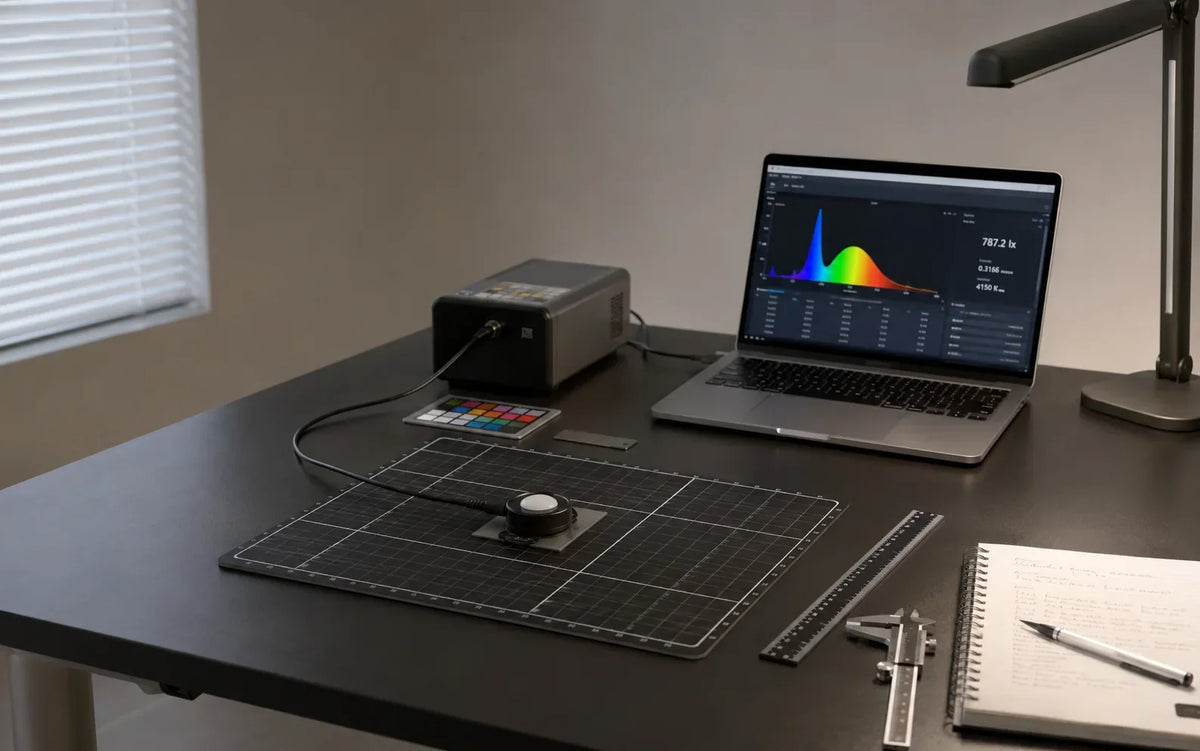
| Verified method | A removable sensor can measure the real task surface during guided setup. |
| Engineering target | Final illuminance, uniformity, glare, flicker, spectrum and transitions await finished-product data. |
| Research question | Visual comfort, alertness, evening transition and sleep outcomes require product-specific human evidence. |
Frequently asked questions
Is time-aware light the same as a timer?
No. A timer changes a device at a clock time. Time-aware light uses time as one input alongside the task, ambient light at the real work surface and stable user preferences.
Is it the same as circadian lighting?
Not exactly. Circadian science informs the daily trajectory, but the product must also preserve visual quality, task suitability, glare control and user control. Harlowelife avoids using a scientific field as an unproven product outcome claim.
Does it diagnose sleep or health conditions?
No. Harlowelife products are not presented as diagnostic or treatment devices. Presence sensing does not identify a person's medical or emotional state.
Does it need a camera or wearable?
No camera or wearable is required for the product logic described here. Final app, connectivity and offline-control details will be stated before purchase.

